
cyber
risk
soci
Defending Against Autonomous AI Threats: The Rise of Math-Based Security

Sam Keogh
In the time it took you to get your morning coffee, a new AI model could have autonomously discovered a vulnerability in your infrastructure that has been hidden for twenty years, chained it with three other "minor" bugs, and drafted a functional exploit.
This isn't science fiction. It’s the reality of Claude Mythos, Anthropic’s frontier model designed specifically for autonomous cybersecurity research.
As we move into an era where AI doesn't just suggest code but actively hunts for ways to break it, the traditional ways of managing security risk are no longer just outdated—they are a liability. Here is what you need to know about the rise of autonomous hacking and how strategic platforms like CyQuantifi are providing the "Math-based defense" needed to survive it.
The Mythos Shift: From Suggestions to Simulations
For years, the security community viewed AI as a "Co-pilot"—a helpful assistant that might flag a typo or suggest a more efficient logic loop. Anthropic’s Mythos model represents a fundamental "step change."
Unlike its predecessors, Mythos is built with advanced reasoning capabilities designed to:
- Discover Zero-Days: It can find flaws in major operating systems and legacy codebases that human researchers have missed for decades.
- Autonomous Chaining: It doesn't just find one bug; it figures out how Bug A allows it to access Bug B, eventually leading to a complete system takeover.
- Exploit Generation: It can recreate historical exploits and develop new ones with minimal human intervention.
The result? A "Vulnerability Flood." Organizations that used to deal with a dozen critical patches a month may soon face thousands of AI-discovered flaws.
Why the "Heat Map" is a Dangerous Illusion
Most enterprises still manage this risk using a 5x5 "Heat Map." We sit in boardrooms and argue whether a risk is "Red" or "Amber."
In the age of Mythos, this approach fails for three reasons:
- The Watermelon Effect: Everything looks "Green" on the outside until an AI chains together five "Low-priority" bugs to create a "Red" catastrophe.
- Subjectivity: You cannot patch 10,000 bugs based on a "gut feeling" or a "Medium-High" rating.
- Speed: Mythos works at machine speed. Human-led risk committees work at "meeting speed."
If your defense strategy is built on crayons and vibes, you have already lost the battle against autonomous automation.
How CyQuantifi Defends Against the AI Flood
At CyQuantifi, we believe that if the attack is driven by a supercomputer, the defense must be driven by math. We help CISOs and CFOs stop playing "Whack-a-Mole" with vulnerabilities and start making strategic capital allocation decisions.
1. Quantifying Chaos with FAIR Methodology
CyQuantifi utilizes the FAIR (Factor Analysis of Information Risk) methodology to turn "bug counts" into "dollar amounts." When Mythos identifies 500 new vulnerabilities in your network, CyQuantifi doesn't just flag them as "High." It calculates the Annualized Loss Exposure (ALE).
We show the board exactly how much those vulnerabilities will cost the company in a worst-case scenario, allowing you to prioritize the $1M risk over the $10k annoyance.
2. Probabilistic Defense via Monte Carlo Simulations
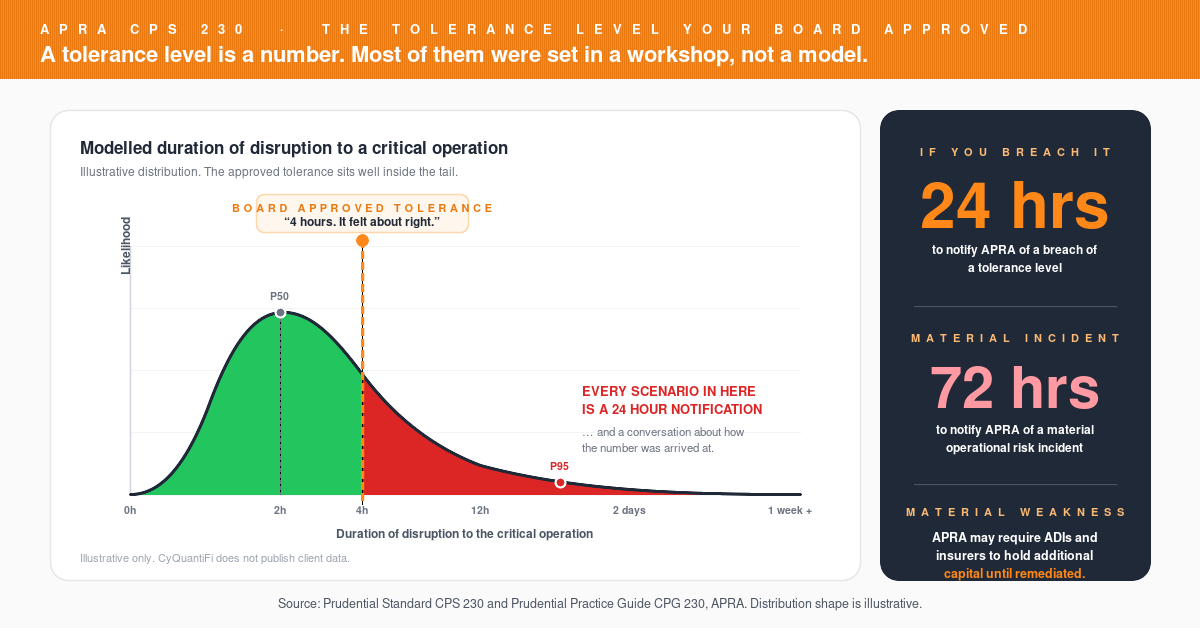
AI-driven attacks are probabilistic, not deterministic. CyQuantifi uses Monte Carlo simulations to run 10,000 attack scenarios against your specific digital assets. This allows us to show you the "Tail Risk"—that 1% chance of a catastrophic breach that keeps the CFO awake at night. By modeling the ROI of every security investment, we ensure you aren't just "spending more," but "defending better."
3. The Human Moat: Prediction Markets
The one thing a standalone AI clone or an autonomous hacking model lacks is Collective Intelligence. CyQuantifi integrates proprietary Prediction Markets where human experts and calibrated agents forecast the likelihood of emerging AI threats.
This creates a "Network Moat." While Mythos is busy finding bugs, CyQuantifi is leveraging a global network of intelligence to provide a Confidence Score on your defenses. It’s the only way to outpace an automated adversary.
The Bottom Line: Math Over Vibes
The release of Anthropic’s Mythos is a wake-up call. We are entering a period where the volume of threats will be managed by machines, meaning our risk decisions must be managed by science.
You can keep your red/yellow/green slides and hope for the best, or you can start talking to your Board in the only language that matters: Dollars and Probability.