cyber
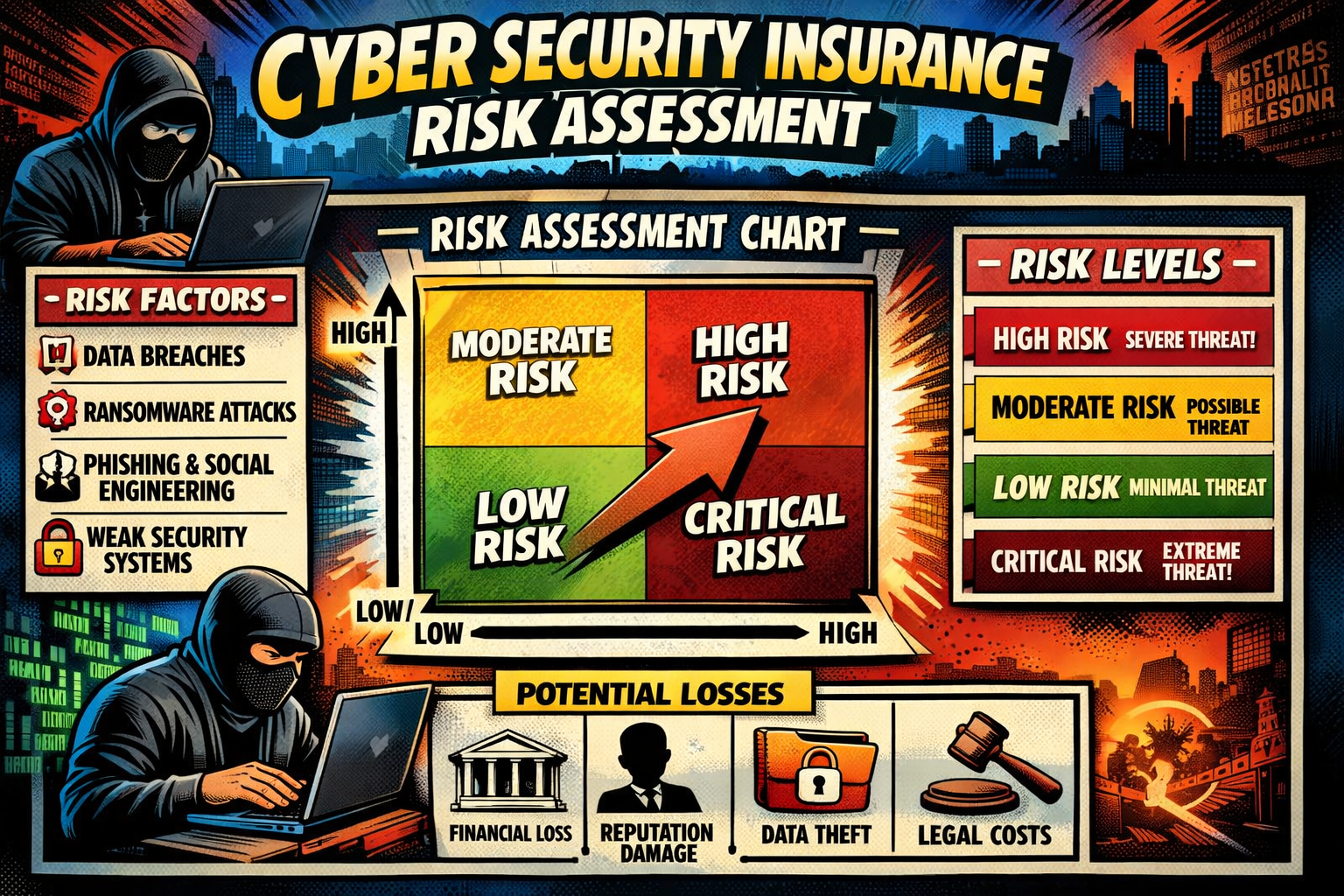

Cyber insurance premiums have surged over the past three years. Carriers are raising rates, narrowing coverage, adding exclusions for ransomware and nation-state attacks, and demanding more evidence before they'll underwrite a policy. If your last renewal felt adversarial, you're not alone.
The root cause isn't just rising claims. It's an information asymmetry that works against you.
Most organisations walk into insurance negotiations with qualitative security assessments — a penetration test report, a compliance certificate, maybe a maturity score from a framework assessment. These tell the underwriter that you've done things, but they don't answer the question the underwriter is actually trying to price: how much financial loss should we expect from cyber events affecting this organisation?
Without that answer, the insurer defaults to industry averages and worst-case assumptions. You pay the premium for the risk they imagine, not the risk you actually carry.
Underwriters aren't mysterious. They're actuaries. They want the same thing any financial professional wants: data they can model with. Here's what moves the needle in a cyber insurance negotiation:
Annual Loss Expectancy (ALE) by scenario. Not a single aggregate number, but a breakdown showing your expected annual loss for specific threat scenarios — ransomware, business email compromise, data exfiltration, third-party breach. When an underwriter sees that you've modelled each scenario independently with defensible inputs, they can price your specific risk profile instead of relying on industry benchmarks.
Confidence intervals from Monte Carlo simulation. A point estimate of "$2.3M annual cyber exposure" is useful. A probability distribution showing the 10th percentile, median, and 90th percentile outcomes is far more useful. Underwriters think in distributions, not single numbers. Presenting your risk in the same language they use internally signals analytical maturity — and analytical maturity correlates with lower loss ratios.
Control effectiveness scores. Insurers want to know that your security controls actually reduce exposure, not just that they exist. A control effectiveness score that quantifies the loss reduction attributable to specific controls — endpoint detection, network segmentation, multi-factor authentication — gives underwriters concrete evidence to justify more favourable terms.
Treatment plans with financial impact projections. Showing that you've identified your highest-exposure scenarios and have a funded plan to reduce them tells the underwriter two things: you understand your risk, and you're actively managing it. Both reduce the perceived likelihood of a large claim.
When you present this data to your broker or directly to the carrier, several things shift in your favour.
Insurance pricing is fundamentally about uncertainty. The less the underwriter knows about your risk, the more margin they build into the premium. Quantitative risk data reduces that uncertainty. You're not asking the insurer to take your word for it — you're showing them a transparent, auditable model with explicit assumptions they can evaluate.
Organisations that present quantified risk data consistently report premium reductions. Not because the data makes them look better than they are, but because it removes the ambiguity premium that carriers charge when they can't see what they're underwriting.
Exclusion clauses are an underwriter's tool for managing scenarios they can't price confidently. If you can demonstrate, with data, that your exposure to a specific threat category is well-understood and actively managed, the underwriter has less reason to exclude it. A Monte Carlo distribution showing your ransomware exposure, combined with control effectiveness data for your backup and recovery capabilities, makes a stronger case than any qualitative assurance.
Over-insurance wastes budget. Under-insurance creates catastrophic gaps. Both are common when coverage decisions are based on rules of thumb or peer benchmarks.
With quantified Annual Loss Expectancy at specific confidence intervals, you can set coverage limits that match your actual exposure. If your 95th percentile annual loss across all modelled scenarios is $8.2M, you can make a data-driven decision about whether to insure for $10M or $15M — instead of guessing.
Underwriters spend time asking questions because they don't have answers. When you proactively provide quantified risk data in a structured format, you compress the underwriting cycle. Fewer follow-up questionnaires. Fewer requests for additional documentation. Faster time to bind.
CyQuantiFi implements the Open FAIR methodology to produce exactly the data that makes insurance negotiations productive.
Scenario-level ALE. CyQuantiFi models individual threat scenarios as graph-based attack trees mapped to MITRE ATT&CK techniques. Each scenario produces its own Annual Loss Expectancy, broken down by loss type — productivity, response, replacement, fines, reputation. This granularity lets you present risk data at the level of detail underwriters need to price accurately.
Monte Carlo confidence intervals. Every scenario in CyQuantiFi runs through Monte Carlo simulation, producing full probability distributions. You can export the 10th, 50th, and 90th percentile values that underwriters use in their own models. The distributions are transparent — every input assumption is visible and auditable, which builds trust with analytically sophisticated carriers.
Control effectiveness quantification. CyQuantiFi measures the impact of each security control on the loss distribution for every scenario it touches. You can show an underwriter that your endpoint detection capability reduces your ransomware ALE by 62%, backed by the simulation data. That's a different conversation than "we have EDR deployed across the enterprise."
Treatment plan projections. CyQuantiFi's treatment planning capability models the before-and-after financial impact of proposed security investments. If you're planning to implement network segmentation, CyQuantiFi shows the projected reduction in ALE across affected scenarios. Present this to your insurer and they can see that your risk profile is improving, not static.
Start at least 90 days before your renewal date. Model your top five threat scenarios in CyQuantiFi, calibrate the inputs with your security team, and run the simulations. Package the outputs into a risk summary that includes scenario-level ALE, aggregate exposure at the 90th and 95th percentiles, control effectiveness for your key security investments, and your treatment roadmap for the next 12 months.
Share this with your broker before they approach the market. A broker armed with quantified data can tell a different story to carriers — one grounded in financial analysis rather than qualitative assurance.
The organisations that get the best cyber insurance terms aren't necessarily the ones with the strongest security posture. They're the ones that can prove it with data.
Cyber insurance is a financial product. Underwriters make pricing decisions based on financial models. If you show up to the negotiation with qualitative ratings and compliance certificates, you're speaking a different language than the person setting your premium.
Quantitative risk data — ALE, Monte Carlo distributions, control effectiveness scores, treatment projections — speaks the underwriter's language fluently. It reduces the uncertainty premium, narrows exclusions, right-sizes coverage, and accelerates the process.
Your security program is an investment. Your insurance should reflect the return on that investment. Quantitative risk data is how you make that case.